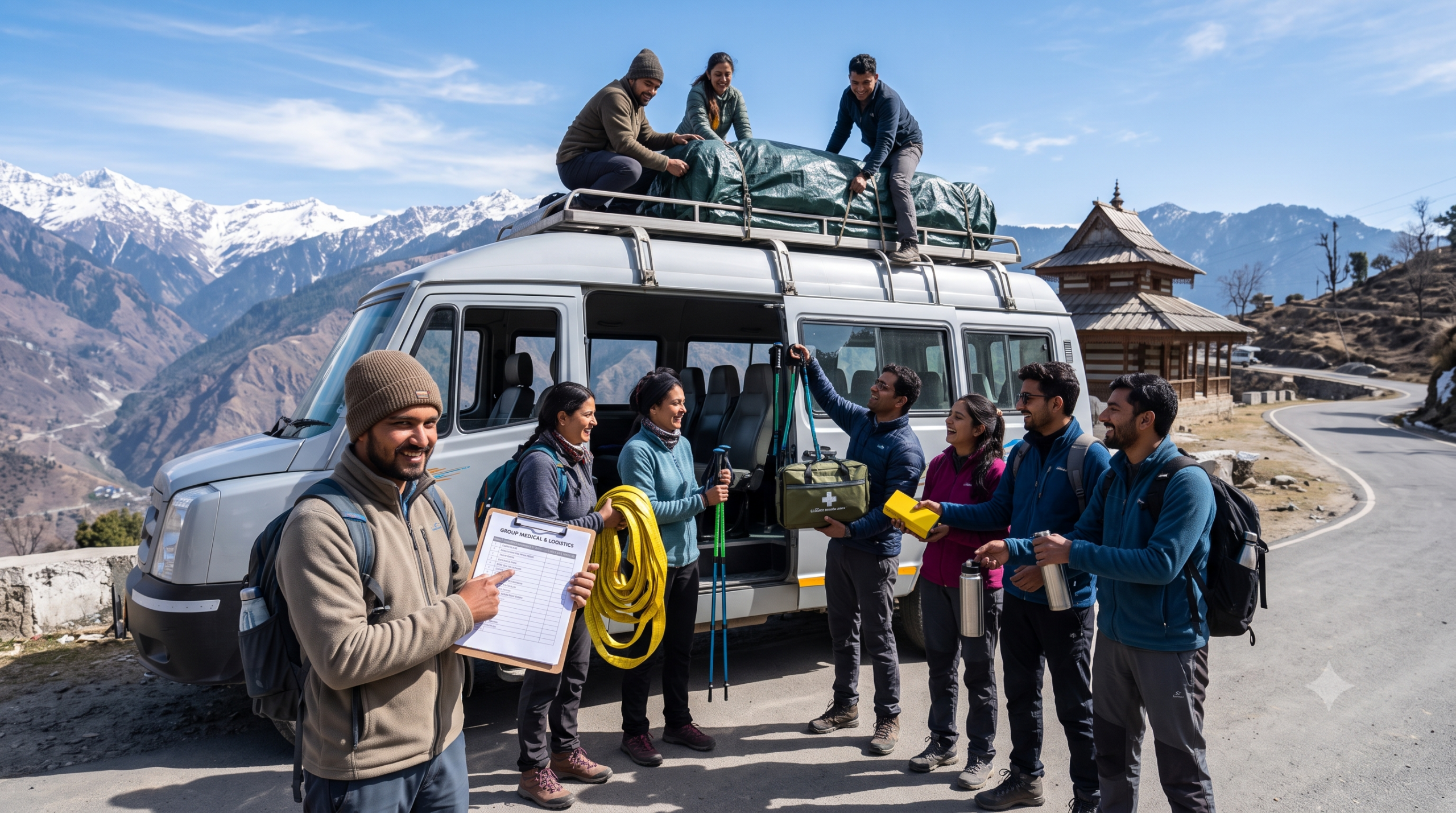
Organizing a group trip to Himachal Pradesh sounds straightforward until mismatched packing styles, different physical fitness levels, and a rental tempo traveler collide on a single-lane mountain road.
Whether you are coordinating your own private road trip or booking pre-planned himachal group trips from delhi, managing logistics before departure is essential—especially around vehicle selection, shared expenses, medical prep, and luggage distribution.
1. Group Transit & Vehicle Logistics Checklist
Mountain hairpin bends, narrow village cut-offs, and payload weights make vehicle planning the most critical phase for any group larger than four people.
- Choose the Right Vehicle Capacity:
- 4 to 6 people: Full-size SUV (Innova Crysta or Scorpio-N). Avoid sedans or compact hatchbacks when traveling with luggage for more than 3 days.
- 7 to 12 people: 12-seater Force Urbania or Tempo Traveler with high ground clearance. Ensure the vehicle has a functional roof carrier with a heavy-duty waterproof tarpaulin.
- Verify Mountain Driver Credentials: Confirm your driver has multi-season mountain driving experience and valid commercial transport permits.
- Booking Organized Departures: If you want to bypass the hassle of self-arranging permits, drivers, and route timing from the capital, choosing a curated fixed departure tour from delhi is often the smoothest way to ensure scheduled rest stops and vetted mountain transport.
- Confirm Green Tax & Rohtang/Pass Permits: If driving personal or self-drive commercial rental cars (especially non-HP registrations), verify whether your route requires advance online eco-permits (such as the Green Tax for Manali or Rohtang Pass entry permits via the district administration portal).
- Rule for Luggage: Enforce a strict “one duffel bag/backpack + one small daypack per person” rule. Hard-shell rectangular suitcases pack poorly on vehicle roof racks and eat up cabin foot-room.
2. Group Medical & First-Aid Kit
Do not rely on each individual to carry a complete pharmacy. Assign one or two designated group members to carry a centralized, waterproof medical kit.
| Category | Must-Have Items | Purpose |
| Motion Sickness | Avomine or Domperidone | Essential for Ghat roads (take 30 mins before driving). |
| Altitude Support | Diamox (Acetazolamide) & Camphor tablets | For trips crossing 10,000+ ft (Spiti, Rohtang, Chitkul). |
| Digestive Care | ORS sachets, Norflox-TZ, Pudin Hara, Eno | Water/food changes and long transit hours. |
| Wound & Sprain Care | Crepe bandage, Volini spray, Band-aids, Betadine | Slip/trip injuries during day walks and river crossings. |
| Emergency Diagnostics | Portable fingertip pulse oximeter & digital thermometer | Monitoring oxygen levels above 9,000 ft. |
3. Shared Gear and Utility Checklist
Avoid luggage redundancy by delegating communal gear across the group instead of everyone packing the same heavy tools:
- 1x 20,000–30,000 mAh High-Output Power Bank per vehicle/room: For remote homestays with single-socket rooms.
- 1x Multi-Plug Extension Board (Spike Guard): Vital in older heritage guesthouses and mountain homestays where rooms only have one or two working outlets.
- 1x Portable Vehicle Tyre Inflator & Tow Strap: Non-negotiable if self-driving multi-car convoys through interior routes.
- Offline Maps & Navigation: Ensure at least two members download entire regional Google Maps / MapMyIndia maps for offline navigation before departing base towns.
- 2x High-Lumen Rechargeable Torches / Headlamps: Power cuts are standard across remote valley belts during weather shifts.
4. Personal Packing Checklist for Every Traveler
Distribute this baseline checklist to every group member to avoid last-minute mountain market purchases:
[ ] Layer 1: Moisture-wicking base layers / thermal tops & bottoms (especially Oct–April)
[ ] Layer 2: Warm fleece pullover or breathable wool sweater
[ ] Layer 3: Windproof and water-resistant outer jacket
[ ] Footwear: 1 pair broken-in trekking/walking shoes with deep tread + 1 pair casual slip-ons
[ ] Woolen socks (minimum 3–4 pairs) and breathable cotton socks
[ ] UV-400 polarized sunglasses (essential for high-altitude snow and river glare)
[ ] Sunscreen (SPF 50+) and petroleum jelly / heavy-duty lip balm
[ ] Quick-dry microfiber towel
[ ] Reusable insulated water bottle (thermos flask for hot water)
[ ] Personal government ID original (Aadhaar / Passport / Driver's License)
5. Group Budget, Cash, and Communication Rules
- Appoint a Single Trip Treasurer: Use split-expense apps (Splitwise or Tricount) logged in offline mode. Have one person pay fuel, toll taxes, and common meals from a pooled float to prevent 10 separate UPI scans at small dhabas.
- Emergency Cash Reserves: Maintain a combined group cash reserve of ₹10,000 to ₹15,000 in ₹100 and ₹200 notes. Remote valley fuel stations and homestays frequently lose cellular network connectivity, making digital UPI payments impossible.
- Designated SIM Networks: Ensure at least one person in the group has an active Jio connection and another has BSNL. Airtel performs well in major hubs (Shimla, Dharamshala, Manali), but BSNL and Jio maintain voice signals deeper into remote transit corridors.
Frequently Asked Questions
What is the ideal group size for a road trip to Himachal?
Groups of 4 to 6 people (in one full-size SUV) or 8 to 10 people (in a single Tempo Traveler) are the most efficient. This size strikes the best balance between shared vehicle costs, easy homestay accommodation, and manageable turnaround times on the road.
How much cash should a group carry while traveling in Himachal?
Carry at least ₹2,500 to ₹3,500 per person in physical cash for remote circuits like Spiti, Kinnaur, or Tirthan Valley. While major towns have working ATMs and UPI, roadside dhabas, local mechanics, and remote homestays often face server outages or power cuts.
Why choose fixed departure tour from Delhi over a self-planned trip?
A fixed departure tour from Delhi eliminates the logistical stress of negotiating tempo traveler rates, organizing multi-room homestay bookings in remote villages, and managing mountain highway toll permits, allowing groups to focus entirely on the experience.
How should our group handle Diamox (AMS medication) for high altitudes?
Consult a physician before the trip. If prescribed, standard acclimatization protocol usually starts 24 hours before ascending past 8,500 feet (such as crossing into Atal Tunnel, Rohtang, or Spiti Valley). Ensure all group members hydrate with at least 3–4 liters of water daily rather than consuming excess caffeine or alcohol.
How do we handle room bookings for large groups in small mountain villages?
In smaller hubs like Jibhi, Shoja, Kalpa, or Naggar, boutique homestays typically only have 3 to 6 rooms total. For groups larger than 6 people, book entire properties at least 3 to 4 weeks in advance rather than expecting to find walk-in rooms next door to each other.